Sakakibara Kenkichi — He Saved Swordsmanship by Making It a Show
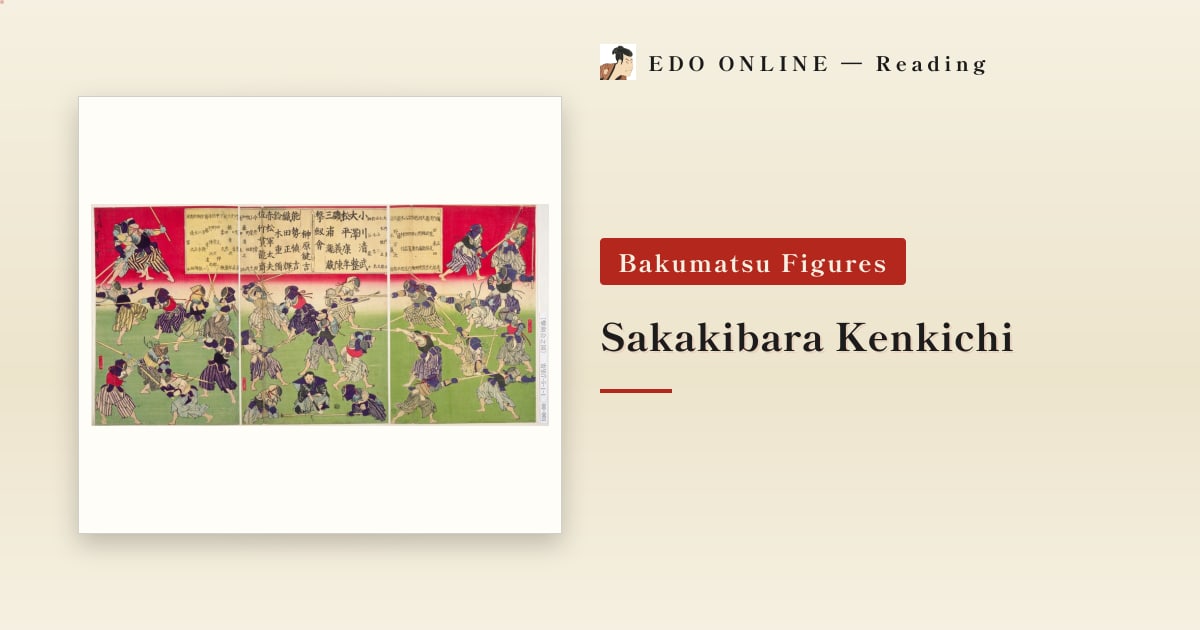
When Japanese swordsmanship was on the point of dying out, one man saved it by turning it into a show. Sakakibara Kenkichi — remembered as "the last swordsman."
Contents
Who Was Sakakibara Kenkichi?
Sakakibara was a swordsman of the late Edo and Meiji periods, and a master of the Jikishinkage-ryu.
Three things define him.
A shogunal fencing instructor. When the Kobusho opened in 1856 he was appointed an instructor of swordsmanship.
The founder of the gekken shows. In 1873 he put fencing matches on as a paid public spectacle — and that is what kept the art alive.
The man who cut a helmet. He is known for cutting deeply into an iron helmet with a sword in front of the Meiji emperor.
He was born on 19 December 1830 and died on 11 September 1894.
Sakakibara Kenkichi from Odani's School to the Kobusho
At thirteen Sakakibara entered the school of Odani Seiichiro.
Odani was regarded as the finest swordsman in Edo — a relative of Katsu Kaishu, and by contemporary account outstanding in character as well as technique.
Sakakibara mastered the Jikishinkage-ryu there.
In 1856 the shogunate founded the Kobusho, an academy teaching both martial arts and Western military methods — one of Abe Masahiro's measures.
Sakakibara became an instructor of swordsmanship there on Odani's recommendation — a fencing master with official standing.
When the Kobusho was abolished in 1866 he served as captain of a guard unit.
Why Swordsmanship Nearly Died in Meiji Japan
After 1868 Sakakibara's world disappeared.
The samurai class was abolished and the sword ban made it illegal to wear a sword in public. Fencing became a skill with no use.
Armies fight with rifles. The police did not require fencing. Nobody came to the training halls. Fencing masters could no longer earn a living.
What followed was halls closing one after another and traditions dying out.
A body of technique built up over centuries was on course to vanish inside twenty years.
Sakakibara Kenkichi's Gekken Shows
Sakakibara's answer was not an obvious one.
He turned fencing into a paid public entertainment.
In 1873 he organised the Gekken-kai and obtained official permission for the gekken kogyo, "public fencing shows." The first was held on 11 April at Saemon-gashi in Asakusa.
The format was simple: fencers fought in front of a paying audience — gate money, ranked cards, and bouts to watch, on the model of sumo.
The fencing world looked down on it. Turning a warrior's skill into a sideshow.
Sakakibara's judgment was, in the event, right.
The reason is plain. A show meant fencers could earn. Earning meant they could keep training. Training meant the technique got passed on. Commercialising it supported the swordsmen and contributed substantially to the art's survival and revival.
Meiji swordsmanship survived by way of that spectacle. The police later adopted fencing, schools took it up, and the line runs on to modern kendo — across a narrow bridge Sakakibara built.
Sakakibara Kenkichi's Helmet-Cutting Feat
What made him most famous is the helmet cut.
In 1887 martial arts were demonstrated before the Meiji emperor. Sakakibara struck an iron helmet with a sword and cut deeply into it, by contemporary account. He did not split the bowl in two; the figure handed down is a cut some ten centimetres long and a centimetre and a half deep.
He was already in his late fifties. And cutting iron with a sword is not, ordinarily, a thing that can be done.
The demonstration made one point visible: fencing was not a useless skill.
The type of sword and helmet and the exact measurements vary between accounts, but that a helmet cut took place before the emperor is widely recorded.
How Sakakibara Kenkichi Died
After the Restoration Sakakibara opened a training hall at Kurumazaka in Shitaya and went on teaching.
He is said not to have lived comfortably. He had been a Tokugawa retainer and did not serve the new government. The shows did not keep drawing crowds indefinitely.
He died on 11 September 1894, aged sixty-three.
"The last swordsman" does not mean he was the strongest. He trained in the sword as a warrior's craft, lived through the era in which it became useless, and did not put it down. That position is what "last" describes.
Sakakibara Kenkichi Timeline
| Year | Event |
|---|---|
| 19 Dec 1830 | Born |
| early 1840s | Enters Odani Seiichiro's school at thirteen; masters the Jikishinkage-ryu |
| 1856 | Appointed fencing instructor at the Kobusho on Odani's recommendation |
| 1866 | Serves as a guard-unit captain after the Kobusho is abolished |
| early Meiji | Opens a training hall at Kurumazaka in Shitaya |
| 11 Apr 1873 | Organises the Gekken-kai; first gekken kogyo at Saemon-gashi, Asakusa |
| 1887 | Reported to have cut deeply into an iron helmet before the emperor |
| 1894 | Dies, aged 63 |
For the halls of Edo see Edo's fencing schools; for the councillor who founded the Kobusho, Abe Masahiro; for contemporaries, Chiba Shusaku and Saito Yakuro.
Related reading
Abe Juro — The Former Member Who Talked
He deserted the Shinsengumi and rejoined under another name, shot at Kondo Isami as one of the Goryō Eji, and then grew apples in Sapporo. His late-Meiji testimony is where the ranking of the corps' best swordsmen comes from.
Ando Hayataro — The Shinsengumi's Record-Breaking Archer
He set the standing national record in the long-range shooting at the Tōdai-ji Great Buddha Hall, sending 8,685 arrows the length of the corridor. Nearly fifty, he joined the Shinsengumi and died of wounds taken in the back garden of the Ikedaya.
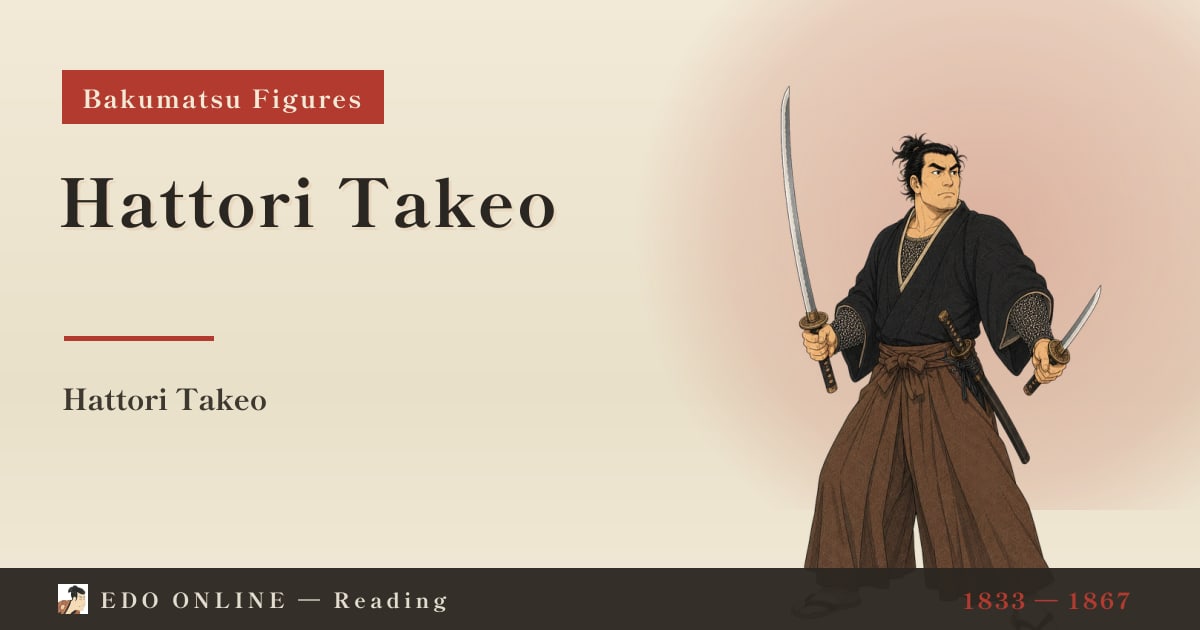
Hattori Takeo — Two Swords at Aburanokoji
A two-sword master and fencing instructor of the Shinsengumi who defected with the Goryō Eji. At Aburanokōji he alone wore mail, held a wall against the whole corps, and fell with more than twenty wounds.