
Saigo Tanomo — The Aizu Elder Whose Household Died Without Him
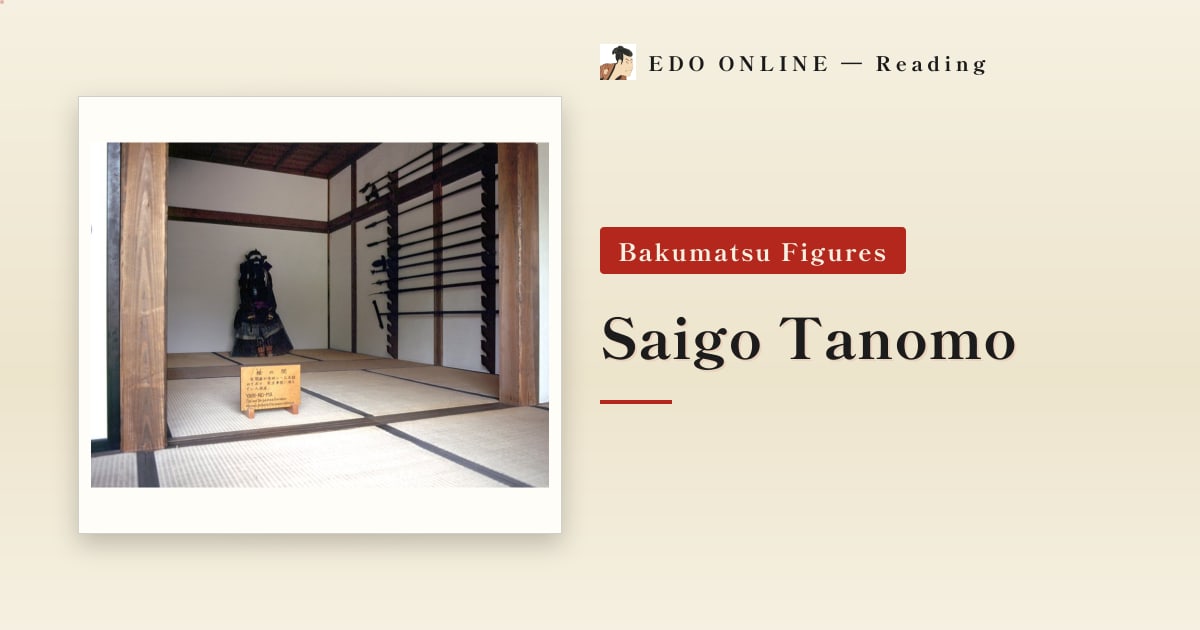
One of the heaviest single events of the Aizu tragedy happened in this man's house. Saigo Tanomo was a chief retainer of Aizu domain.
Contents
Who Was Saigo Tanomo?
Tanomo was a chief retainer of Aizu and, throughout the crisis years, the man who kept arguing that his domain should step back.
He was overruled at the two decisive moments: when he opposed accepting the Kyoto Protector post, and when — after the defeat at Shirakawa — he urged submission and the surrender of the castle. Both times, what he had warned about happened.
He was born in 1830 into a family that had supplied chief retainers for generations — as high as Aizu society went.
Why Saigo Tanomo Argued Against the Kyoto Post
In 1862 the shogunate moved to appoint the Aizu lord, Matsudaira Katamori, as Protector of Kyoto.
The idea was to police a disintegrating capital with Aizu troops. It was an honour, and it was also an invitation to pull chestnuts out of a fire.
Tanomo opposed it strenuously. Pouring the domain's strength into Kyoto would ruin its finances, and it would concentrate the hatred of every faction on Aizu alone. He put this to his lord repeatedly.
Katamori accepted anyway. Aizu's house code enshrined loyalty to the Tokugawa, and refusal was effectively not available.
Tanomo went on objecting until he was no longer heard, and was eventually stripped of his office and placed under house confinement.
And events followed his prediction: Aizu took charge of the Shinsengumi in Kyoto, absorbed the enmity of the loyalist movement, and was branded an enemy of the court in the Boshin War.
Saigo Tanomo's Argument for Surrender
When war came he was recalled and given command at the Shirakawa front.
He was defeated there and held responsible. He then argued that the fighting should stop — that there was no path to victory and the castle should be surrendered.
This too was rejected. In an atmosphere where resistance to the last man was equated with loyalty, anyone urging surrender was a defeatist.
The Twenty-One Suicides in Saigo Tanomo's Household
In the autumn of 1868 imperial troops broke into the castle town.
In the Saigo residence near the castle, twenty-one members of Tanomo's family died. His wife Chieko, his mother, his sisters, and his young daughters were among them. The youngest children could not take their own lives and were killed by their mother, according to the accounts.
Why It Happened
There is no single reason.
The value system the women of warrior households lived inside. Death was held preferable to capture and dishonour, and the two were bound to the standing of the house.
A judgment about being a burden. For men shut inside a castle, family left outside was a liability. Removing themselves was understood as freeing the fighters to fight.
The position of a chief retainer's household. A family at the centre of the domain was arguably under pressure to set the example — though this is a later reading rather than something the participants recorded.
And Tanomo was not there. He had gone up to the castle with his eldest son, Kichijuro, and was not present at his family's deaths. The household of the man who had argued for stepping back died in the most extreme way available.
Saigo Tanomo's Life Afterward
When Aizu surrendered, Tanomo fled north and fought at Hakodate alongside Enomoto Takeaki. He was defeated there as well, captured, and imprisoned.
After his release he took the name Hoshina Tanomo and lived as a Shinto priest, serving at shrines in Nikko and in Fukushima. He spent the rest of his life not as a warrior but as a man in religious service.
His adopted son, Saigo Shiro, became a celebrated judoka of the Kodokan and is generally taken as the model for the novel Sugata Sanshiro. Tanomo is sometimes credited with a martial tradition of his own, but much of that account is later embellishment.
He returned to Aizu in old age and died in 1903, aged seventy-two.
He had lived thirty-five years after losing his household.
Saigo Tanomo's Descendants
People often search for what became of Tanomo's line.
With twenty-one family members dead in the residence, the direct line is a complicated question, and Saigo Shiro was an adopted heir rather than a blood relation. The genealogies of the Aizu houses were severed on a large scale by the Boshin War, and the Saigo family was not an exception.
A reconstruction of the Saigo residence in Aizu-Wakamatsu presents the scene of the deaths to visitors.
Saigo Tanomo Timeline
| Year | Event |
|---|---|
| 1830 | Born into a chief retainer family of Aizu |
| 1862 | Opposes the Kyoto Protector appointment; is removed and confined |
| 1868 | Recalled for the Boshin War; defeated at Shirakawa |
| 1868, autumn | Twenty-one members of his family die at the Saigo residence |
| 1869 | Fights at Hakodate; captured and imprisoned |
| Meiji era | Takes the name Hoshina Tanomo and serves as a Shinto priest |
| 1903 | Dies in Aizu, aged 72 |
For the war from the Aizu side see Aizu domain and the Boshin War.
Related reading
Abe Juro — The Former Member Who Talked
He deserted the Shinsengumi and rejoined under another name, shot at Kondo Isami as one of the Goryō Eji, and then grew apples in Sapporo. His late-Meiji testimony is where the ranking of the corps' best swordsmen comes from.
Ando Hayataro — The Shinsengumi's Record-Breaking Archer
He set the standing national record in the long-range shooting at the Tōdai-ji Great Buddha Hall, sending 8,685 arrows the length of the corridor. Nearly fifty, he joined the Shinsengumi and died of wounds taken in the back garden of the Ikedaya.
Hattori Takeo — Two Swords at Aburanokoji
A two-sword master and fencing instructor of the Shinsengumi who defected with the Goryō Eji. At Aburanokōji he alone wore mail, held a wall against the whole corps, and fell with more than twenty wounds.