
Who Was Fukuzawa Yukichi? Life and Learning Explained
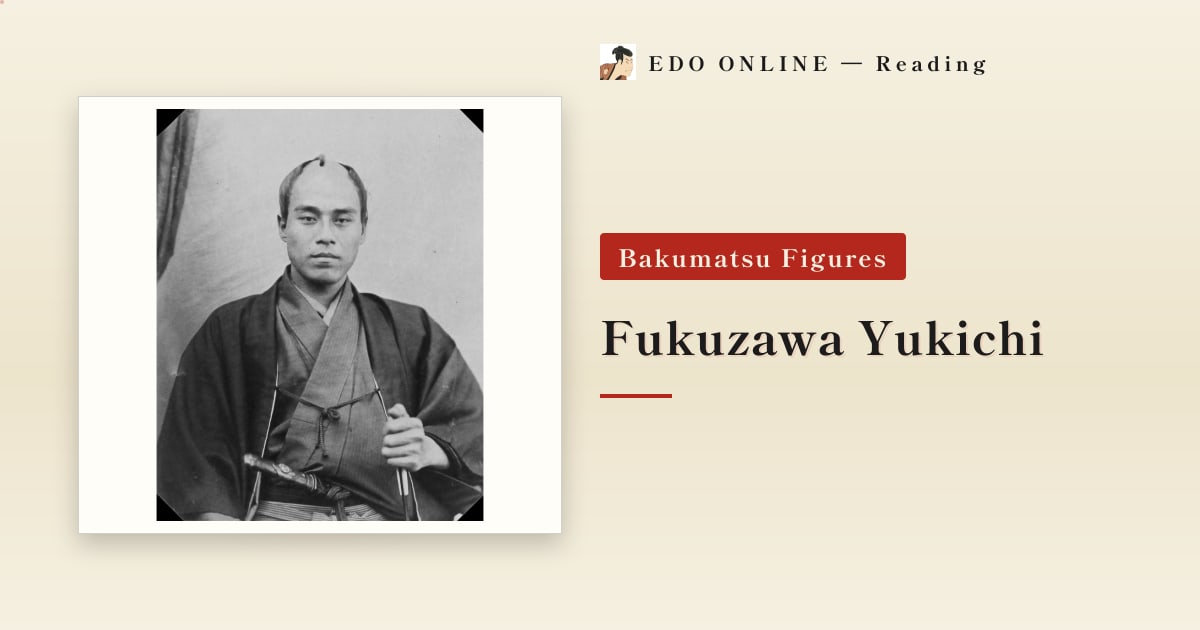
Fukuzawa Yukichi moved his age with words rather than swords. He carried Western knowledge into Japanese, put it within reach of ordinary readers, and left a deeper mark on modern Japan than most of the men who fought for it.
Contents
What did Fukuzawa Yukichi do?
In a sentence: he translated Western knowledge into Japanese and made learning available to everyone. Four achievements carry most of the weight.
| Achievement | Detail |
|---|---|
| Founded Keiō Gijuku | A school teaching practical subjects without regard to birth, setting the pattern for modern Japanese education |
| Wrote An Encouragement of Learning | Written in plain language, it became one of the best-selling books of the century |
| Translated and introduced Western knowledge | Conditions in the West and other works described European and American institutions and daily life |
| Founded the newspaper Jiji Shinpō | Practised political influence through journalism |
He never held government office. Unlike almost every other significant figure of the period, Fukuzawa remained a private citizen and a writer for his entire career.
Fukuzawa Yukichi and the Tekijuku
Fukuzawa was born in early 1835 at his domain's warehouse compound in Osaka, the son of a Nakatsu domain samurai. He took up Dutch learning young and studied at Ogata Kōan's Tekijuku in Osaka, eventually becoming its head student.
Then came the shock that redirected his life. Visiting newly opened Yokohama, he found that nobody there spoke Dutch. Years of hard study were suddenly worth very little. He began learning English the next day.
Fukuzawa Yukichi and the West
Fukuzawa travelled abroad three times with shogunal missions, crossing to America aboard the Kanrin Maru with Katsu Kaishū and later touring Europe.
What interested him was not the technology. It was how Western societies were organised: their institutions, their schools, the assumptions ordinary people held. He was less impressed by steam engines than by the fact that citizens argued with their governments.
Keio Gijuku
On returning he opened a school teaching Western subjects, which became Keiō Gijuku and is now Keio University.
Its principles were that birth should not determine admission and that learning should be practical. Both were radical in a society organised by inherited status.
What "Heaven does not create one person above another" really means
The opening of An Encouragement of Learning is among the most quoted lines in Japanese.
It is said that Heaven does not create one person above another, nor one person below another
It is almost always read as a declaration that all people are born equal. That is not what Fukuzawa was arguing.
Note the phrase "it is said." Fukuzawa is reporting a proposition, not asserting one. He immediately continues that in reality there are wise and foolish people, rich and poor, and the differences are stark. So where do they come from? His answer: "they arise from whether or not one has studied."
An Encouragement of Learning is therefore not a statement about equality but an argument that education, not birth, determines a person's position — so study. For a man raised in a society where birth decided everything, this was a quiet and radical claim.
Fukuzawa Yukichi stories
Testing divine punishment. As a boy he trod on a paper charm to see whether anything would happen, then swapped the sacred object in a shrine for a stone and watched people worship it. He tells the story himself in his autobiography. The refusal to take authority on trust never left him.
Switching from Dutch to English. Described above. The point is not the setback but the response: he restarted from zero the following day.
He never drew a sword. During the years of anti-foreign violence, a scholar of Western learning was a natural target. He avoided the streets at night and spent periods in hiding, and records this frankly. He neither killed nor was killed, and moved his age with words alone.
On the mummy story. A claim that circulates online. It has no basis in evidence. Fukuzawa suffered a stroke in 1898, recovered, and died after a second in 1901; there is no reliable record of any unusual preservation of his body.
Fukuzawa Yukichi's family
His wife was Kin, daughter of a Nakatsu domain samurai, with whom he had four sons and five daughters.
Fukuzawa was unusual for his time in arguing against distinctions between men and women within the household, and criticised conventional teaching on women's conduct sharply in his own writing.
Why was Fukuzawa Yukichi on the 10,000 yen note?
Fukuzawa appeared on the 10,000 yen note from 1984 until 2024, when he was replaced by Shibusawa Eiichi — forty years in circulation.
The reasons usually given are that he was a cultural rather than political figure of the modern period, and that he had laid foundations in education and public discourse. Japanese banknote policy at the time deliberately favoured cultural figures over politicians and soldiers; Nitobe Inazō on the 5,000 yen note and Natsume Sōseki on the 1,000 were selected on the same basis.
Four decades of circulation are why "a Fukuzawa" became slang for the note itself.
Timeline of Fukuzawa Yukichi's life
| Year | Event |
|---|---|
| 1835 | Born at the Nakatsu domain compound in Osaka |
| 1854 | Goes to Nagasaki to study Dutch learning |
| 1855 | Enters the Tekijuku in Osaka; later becomes head student |
| 1858 | Opens a school of Dutch learning in Edo, the origin of Keiō |
| 1860 | Crosses to America aboard the Kanrin Maru |
| 1862 | Travels through Europe with a shogunal mission |
| 1866 | Publishes Conditions in the West |
| 1872 | Publishes the first part of An Encouragement of Learning |
| 1882 | Founds the newspaper Jiji Shinpō |
| 3 Feb 1901 | Dies, aged 66 |
Frequently asked questions
Who was Fukuzawa Yukichi?
A writer and educator who founded Keiō Gijuku, introduced Western knowledge to Japan in accessible language, and wrote An Encouragement of Learning.
What does "Heaven does not create one person above another" mean?
Not that people are equal in fact. Fukuzawa cites the idea and then argues that real differences between people come from education, so people should study.
Was Fukuzawa Yukichi on the 10,000 yen note?
Yes, from 1984 to 2024, when Shibusawa Eiichi replaced him.
Did Fukuzawa Yukichi hold political office?
No. He remained a private educator and journalist throughout his life.
For the school where he studied see Rangaku and the Tekijuku; for his fellow traveller to America see Katsu Kaishū.
Related reading
Abe Juro — The Former Member Who Talked
He deserted the Shinsengumi and rejoined under another name, shot at Kondo Isami as one of the Goryō Eji, and then grew apples in Sapporo. His late-Meiji testimony is where the ranking of the corps' best swordsmen comes from.
Ando Hayataro — The Shinsengumi's Record-Breaking Archer
He set the standing national record in the long-range shooting at the Tōdai-ji Great Buddha Hall, sending 8,685 arrows the length of the corridor. Nearly fifty, he joined the Shinsengumi and died of wounds taken in the back garden of the Ikedaya.
Hattori Takeo — Two Swords at Aburanokoji
A two-sword master and fencing instructor of the Shinsengumi who defected with the Goryō Eji. At Aburanokōji he alone wore mail, held a wall against the whole corps, and fell with more than twenty wounds.