Bakumatsu Ukiyo-e — Yokohama Prints, Bloody Prints, and Satire
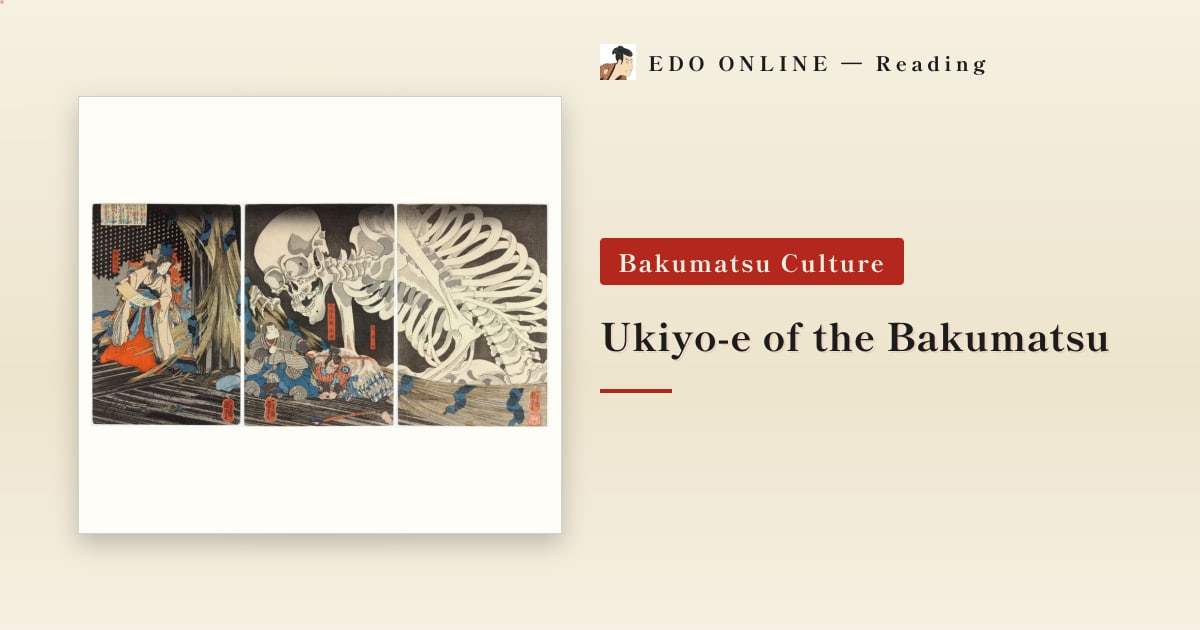
Late ukiyo-e is not landscapes and beauties. It is reportage on the treaty ports, news of assassinations, political satire and outright gore — the chaos of the age became the subject matter.
Contents
What Was Bakumatsu Ukiyo-e?
Ukiyo-e was popular printmaking throughout the Edo period, and the Bakumatsu was its last flourishing.
| Item | Detail |
|---|---|
| Nishiki-e | Full-colour woodblock prints; the standard form by this period |
| Producers | The Utagawa school above all — Hiroshige, Kuniyoshi, Toyokuni III |
| New subjects | Yokohama prints, "enlightenment" prints, news scenes, muzan-e |
| Production | A division of labour — artist, carver, printer, publisher. The publisher commissioned it as a product |
| End | Photography and letterpress take over the recording function |
Ukiyo-e and nishiki-e are not opposites: nishiki-e simply means the full-colour woodblock print, which is what almost all Bakumatsu ukiyo-e is.
The key point is that a print was a commercial product before it was art. What sold got made — which is why these prints are such a good index of what people were interested in.
Yokohama-e — Prints About the Foreigners
After Yokohama opened in 1859 came Yokohama-e.
They show foreigners, Western buildings, steamships, carriages, foreign customs, and Gountei Sadahide produced many of them.
For contemporaries these functioned as news photographs. You could not get to Yokohama, so you bought the view in Edo. Ukiyo-e was working as information.
Accuracy varies, and some are imagined from hearsay. That too is a record — of how Japanese people pictured the outside world.
Muzan-e and the News Trade
Distinctive to the period are muzan-e, the "bloody prints."
Tsukioka Yoshitoshi and Ochiai Yoshiiku — both students of Kuniyoshi — produced bodies of work depicting bloodshed and violence head-on.
Why did they sell? Because assassination and war were actually happening. With rumours of the Sakuradamon Incident and the Ikedaya circulating, people wanted images of violence.
Prints about current events appeared too — but criticism of shogunal policy was forbidden, so most were disguised as historical or theatrical scenes.
The Tenpo Reforms and Satire
Prints were a regulated product.
During the Tenpo Reforms of 1841–43, Mizuno Tadakuni cracked down on public morals and banned actor prints and pictures of beauties.
Kuniyoshi's response is famous: he drew actors in forms that were not portraits, replaced them with animals or scribble-style figures, and worked around the ban. Some pieces were read as mocking those in power.
Regulation changed the form. The abundance of visual puzzles and substitution imagery in late ukiyo-e is not unrelated to that experience.
Why Ukiyo-e Ended
It lost ground fast after 1868, for a simple reason: photography and letterpress printing arrived.
- News passed to newspapers (with print-newspapers as a transitional hybrid)
- Recording faces passed to photography
- A workshop of carvers and printers could not match machine printing on speed or price
Abroad, meanwhile, its reputation rose. Van Gogh copied Hiroshige; Sharaku was rediscovered through German scholarship. A form that had finished its job at home was found as art overseas.
Timeline
| Year | Event |
|---|---|
| 1841–43 | Mizuno Tadakuni's Tenpo Reforms ban actor prints; satire and substitution increase |
| 1853 | The black ships; prints of the fleet circulate |
| 1858 | Hiroshige dies |
| 1859 | Yokohama opens; Yokohama prints are mass-produced |
| 1861 | Kuniyoshi dies |
| 1860s | Muzan-e and current-event prints flourish |
| Meiji era | Newspapers, photography and letterpress displace the form; foreign esteem rises |
Frequently Asked Questions
What is the difference between ukiyo-e and nishiki-e?
Nishiki-e means the full-colour woodblock print. Bakumatsu ukiyo-e is essentially all nishiki-e; they are not competing categories.
What are Yokohama-e?
Prints made after the 1859 opening of Yokohama, showing foreigners, Western buildings and ships — effectively news imagery.
What are muzan-e?
Prints depicting bloodshed and violence directly, associated with Tsukioka Yoshitoshi and Ochiai Yoshiiku.
Could printmakers criticise the shogunate?
Not directly. Criticism was disguised as historical or theatrical subjects, or delivered through visual puns.
Why did ukiyo-e decline?
Newspapers, photography and letterpress took over its informational role — even as its artistic reputation abroad grew.
For the artists see Hiroshige, Kuniyoshi, Hokusai and Sharaku.
Related reading
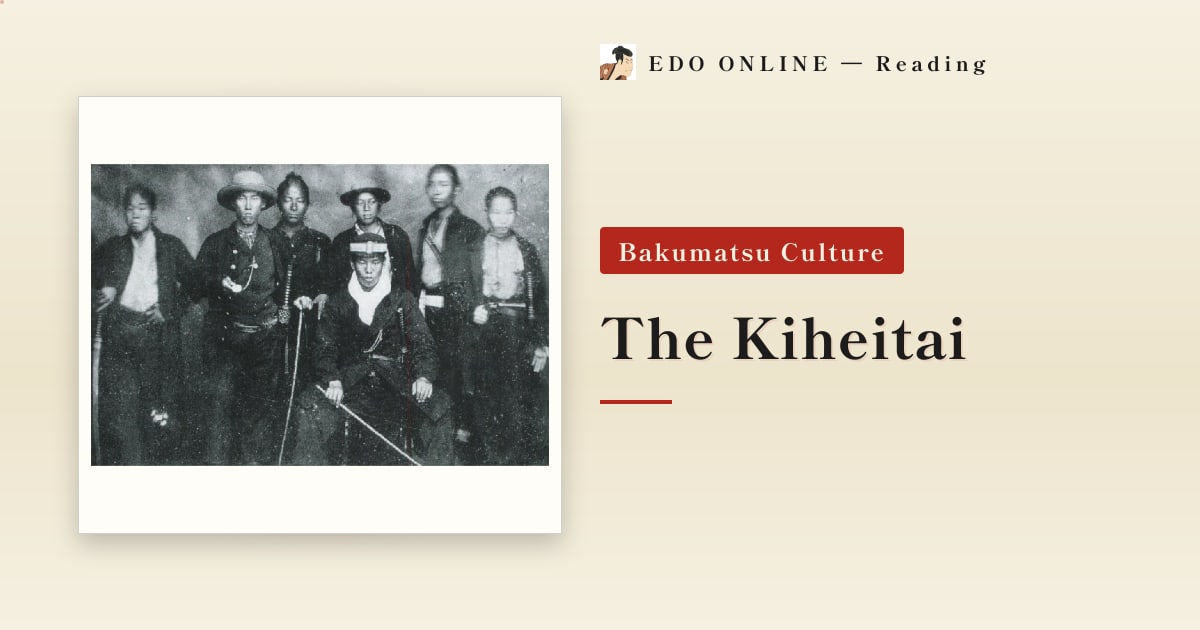
The Kiheitai — Takasugi's Army That Ignored Class
Raised in 1863 by Takasugi Shinsaku, the Kiheitai took commoners as soldiers. Why Choshu did it, how it differed from the regular army, what it won, and how the new government crushed it.
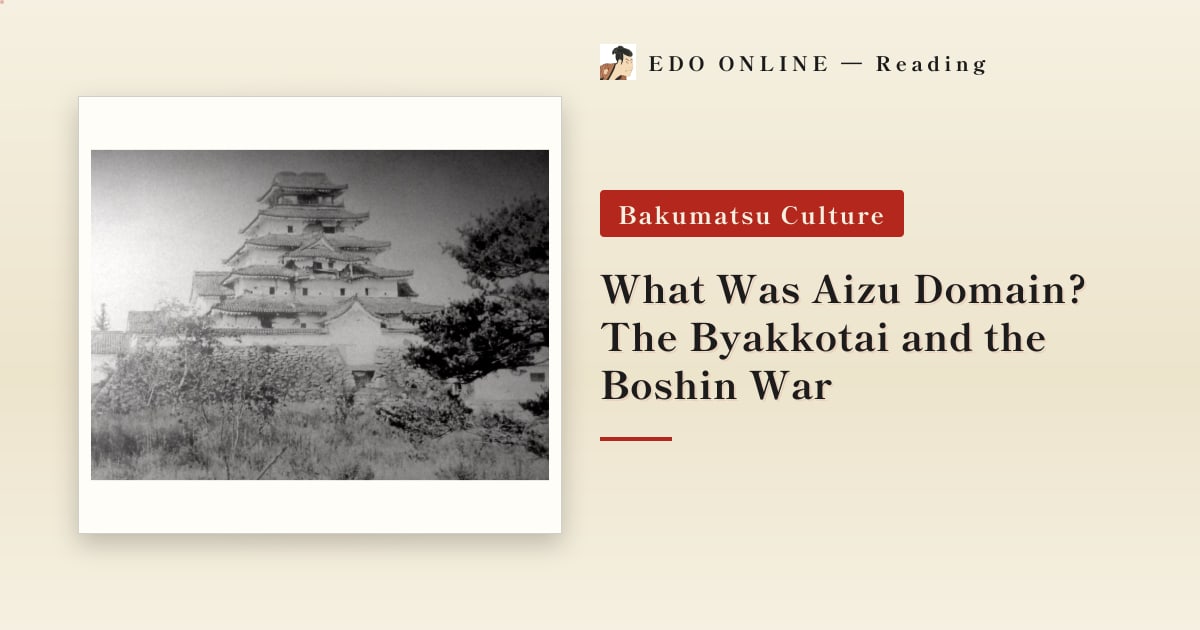
What Was Aizu Domain? The House Code, the Byakkotai, the Siege
Aizu stayed loyal to the shogunate to the end and was destroyed for it. Why Matsudaira Katamori took the Kyoto post, what happened to the Byakkotai, and how the domain was punished.
What Was the Ansei Purge? Ii Naosuke's Crackdown Explained
Between 1858 and 1859 the shogunate's chief minister Ii Naosuke purged more than a hundred opponents and executed eight, including Yoshida Shoin. Why it happened and what it destroyed.