
Shibata Zeshin — The Lacquerer Who Made Lacquer Look Like Iron
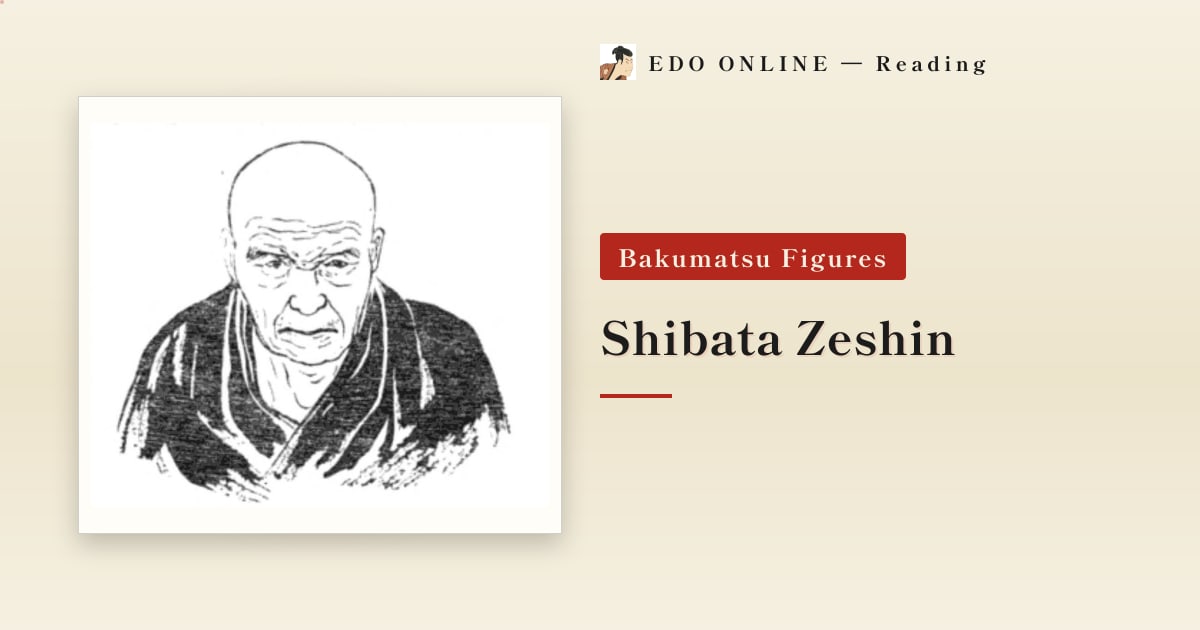
One craftsman painted iron in lacquer, and ceramic in lacquer. Shibata Zeshin — whose subject, in a sense, was making one material pass for another.
Contents
Who Was Shibata Zeshin?
Zeshin was a lacquer artist and painter working from the late Edo period into Meiji.
Three things define him.
He established urushi-e — painting pictures in lacquer on Japanese paper. Lacquer was a coating for objects; he used it as paint.
He invented "variant finishes." These imitate iron, bronze, ceramic and weathered wood in lacquer. He originated bronze finish and shibuichi finish among others.
He was recognised by the Meiji court and abroad. He worked on the ceiling paintings of the Meiji Palace and was appointed an Imperial Household Artist, and his work was prized at the international expositions.
He was born in 1807 at Tachibana-cho in Ryogoku, Edo, and died on 13 July 1891.
Shibata Zeshin's Two Trainings
Zeshin was a child of Edo's downtown.
In 1817, at the traditional counted age of eleven, he began studying maki-e under Koma Kansai II — the traditional craft of drawing in lacquer and fixing gold powder into the line.
In 1822, at the traditional counted age of sixteen, he studied painting under Suzuki Nanrei, in the Shijo school, the Kyoto lineage that emphasised drawing from life.
Those two trainings made him.
At the time, a maki-e man was an artisan and a painter was a painter. Few people trained seriously in both. Zeshin was a lacquer artisan who could draw, and a painter who could handle lacquer.
Shibata Zeshin's Invention of Urushi-e
His signature technique is urushi-e.
Pictures painted in lacquer, on Japanese paper.
This is not easy. Lacquer dries hard and paper is thin. The paper warps, cracks, tears. Drying behaviour shifts with humidity and temperature.
Zeshin brought it under control, and produced vivid lacquer paintings on fan faces and album leaves.
Why go to that trouble? Because lacquer gives a gloss and depth nothing else does — a black pigment cannot reach, a metallic sheen, a surface with body. He chose lacquer to widen what a picture could do.
How Shibata Zeshin Lied in Lacquer
The other thing that made his name is the variant finish.
The technique uses lacquer to make something that does not look like lacquer.
Iron. The reddish, gritty surface of an old rusted iron vessel. Bronze. The green patina of aged bronze — the bronze finish. Ceramic. The crazed surface of fired ware. Old wood. The grain of timber left out in the weather.
Pick it up and it is light. That is the proof it is lacquer. The eye says iron and the hand says otherwise — that gap is the point of the technique.
It is a technology of disguise, and one impossible without a deep understanding of the materials being imitated.
Why Shibata Zeshin Sold Abroad
In the Meiji era Zeshin's work was highly valued overseas.
Beginning with the Vienna World Exposition of 1873, his pieces drew attention wherever Japan exhibited. European and American collectors competed for them.
The reason is that it was work nobody else could do. Western craft had no tradition of handling lacquer this way. The level of the technique was itself the originality.
Much of his work is now held in museums outside Japan — foreign collections are in some respects stronger than domestic ones.
Shibata Zeshin as an Imperial Household Artist
The Meiji Palace was completed in 1888, and Zeshin worked on its ceiling paintings.
In 1890 the Imperial Household Artist system was established, under which the court patronised outstanding artists and craftsmen.
Zeshin was appointed at its inauguration.
He was in his mid-eighties, more than seventy years after starting maki-e lessons in downtown Edo. An Edo artisan had been certified by the Meiji state as a bearer of Japanese skill.
He died on 13 July 1891, aged eighty-four.
How to Look at Shibata Zeshin's Work
The way into his work is to doubt what it is made of.
The box that looks like iron is lacquer. The vessel that looks like pottery is lacquer. The thing that looks like a picture painted on paper is painted in lacquer.
Across the most anxious decades in the history of Japanese craft, Zeshin chose to astonish through technique. Not ideas, not novelty — a craftsman who competed on the skill of his hands alone.
Shibata Zeshin Timeline
| Year | Event |
|---|---|
| 1807 | Born at Tachibana-cho, Ryogoku, Edo |
| 1817 | Begins maki-e under Koma Kansai II, aged eleven by the traditional count |
| 1822 | Studies Shijo-school painting under Suzuki Nanrei, aged sixteen by the traditional count |
| 1830s–60s | Establishes urushi-e; originates bronze and shibuichi finishes |
| 1873 | Recognition abroad, beginning with the Vienna World Exposition |
| 1888 | Works on the ceiling paintings of the Meiji Palace |
| 1890 | Appointed an Imperial Household Artist at the system's inauguration |
| Jul 1891 | Dies, aged 84 |
For contemporary print artists see Utagawa Hiroshige and Utagawa Kuniyoshi; for the print world of the period, Bakumatsu ukiyo-e.
Related reading
Abe Juro — The Former Member Who Talked
He deserted the Shinsengumi and rejoined under another name, shot at Kondo Isami as one of the Goryō Eji, and then grew apples in Sapporo. His late-Meiji testimony is where the ranking of the corps' best swordsmen comes from.
Ando Hayataro — The Shinsengumi's Record-Breaking Archer
He set the standing national record in the long-range shooting at the Tōdai-ji Great Buddha Hall, sending 8,685 arrows the length of the corridor. Nearly fifty, he joined the Shinsengumi and died of wounds taken in the back garden of the Ikedaya.
Hattori Takeo — Two Swords at Aburanokoji
A two-sword master and fencing instructor of the Shinsengumi who defected with the Goryō Eji. At Aburanokōji he alone wore mail, held a wall against the whole corps, and fell with more than twenty wounds.