
Takizawa Bakin — Twenty-Eight Years to Finish One Novel
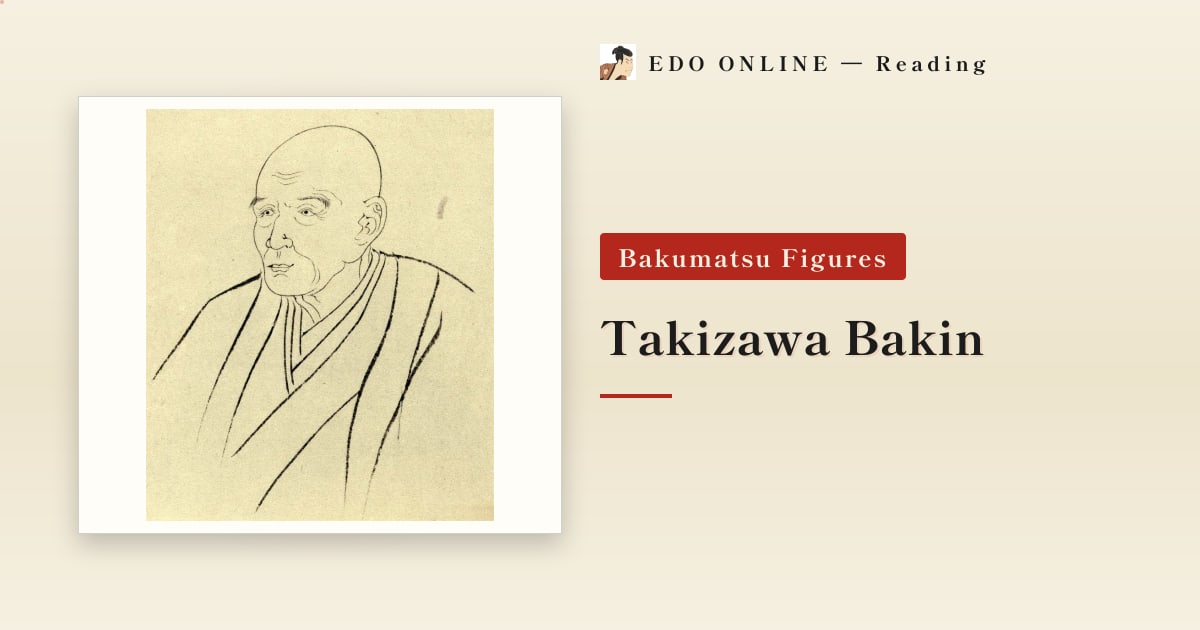
One man spent twenty-eight years writing a single novel. Takizawa Bakin, author of the Nanso Satomi Hakkenden.
Contents
Who Was Takizawa Bakin?
Bakin was a gesaku writer of the late Edo period — a novelist, in current terms. His given name was Takizawa Okikuni, later Toku; Kyokutei Bakin was his art name.
Three things define him.
He wrote the Hakkenden. It runs to nine sets, 106 fascicles, 98 volumes, and took twenty-eight years to finish.
He produced some 470 titles. The sheer volume is of a different order from his contemporaries.
He lived by writing. Anchoring his income in manuscript fees and book sales made him unusual among writers of his time.
He was born in Fukagawa, Edo, in 1767 and died in 1848.
Takizawa Bakin from Picture Books to Novels
Bakin was born in Fukagawa to the steward of a shogunal bannerman — a household in service to a warrior family.
In 1790 he entered the school of Santo Kyoden, a popular author of kibyoshi, short illustrated books.
Bakin began there, but his real field was the yomihon.
A yomihon is a long novel in which the prose, not the pictures, carries the work. Influenced by Chinese vernacular fiction, it handles complex plots and large casts. He moved from light reading to long narrative.
The Twenty-Eight Years of Bakin's Hakkenden
The first instalment of the Nanso Satomi Hakkenden appeared in 1814.
The story follows eight dog warriors in service to the Satomi of Awa, each carrying one of eight scattered beads, gradually finding one another. Each of the eight embodies one virtue — benevolence, justice, propriety, wisdom, loyalty, faith, filial piety, brotherhood — and at the end all eight assemble under a single house.
The manuscript was finished in 1841 and the final volume published in 1842.
Twenty-eight years. A reader who bought the first instalment was middle-aged by the ending. The author was forty-six when publication began and seventy-four when he finished writing.
The finished work runs to nine sets, 106 fascicles and 98 volumes — exceptional in Edo literature for both length and duration.
Takizawa Bakin Went Blind and Kept Writing
Partway through the later volumes, Bakin lost his sight.
He did not stop. He switched to dictating and having someone else write it down.
The person who took the dictation was his son's wife. She could not write well enough at first, so he had her taught to write before she could serve as his amanuensis.
A blind author completed a long novel by speaking it to a woman he had first taught to write.
Was Takizawa Bakin Japan's First Professional Novelist?
The other unusual thing about Bakin is how he made his living.
Most writers of gesaku at the time had a main occupation — samurai, physician, merchant. Writing was a sideline.
Bakin's was not. He put book sales and manuscript fees at the centre of his income.
That meant treating his relationship with publishers as a financial negotiation. He had a sense of selling a work.
The figure of some 470 titles follows from the same stance: if he stopped writing, there was no income.
How Takizawa Bakin Died
Bakin died in 1848, aged eighty-one.
That is six years after the final volume appeared — he finished a long novel in his mid-seventies and lived some years past it.
The book kept being read. It was reprinted repeatedly after 1868, and its plot template runs on into modern manga and animation.
Eight companions, each carrying a token, converging became one of the standard shapes of Japanese narrative.
Takizawa Bakin Timeline
| Year | Event |
|---|---|
| 1767 | Born in Fukagawa, Edo, son of a bannerman's steward |
| 1790 | Enters Santo Kyoden's school as a kibyoshi writer |
| 1800s | Turns to the yomihon |
| 1814 | Publishes the first instalment of the Nanso Satomi Hakkenden at forty-six |
| 1830s | Loses his sight and continues by dictation |
| 1841 | Finishes the manuscript at seventy-four |
| 1842 | The final volume appears — nine sets, 106 fascicles, 98 volumes, twenty-eight years |
| 1848 | Dies, aged 81 |
For a contemporary gesaku writer see Jippensha Ikku; for an illustrator of his work, Katsushika Hokusai.
Related reading
Abe Juro — The Former Member Who Talked
He deserted the Shinsengumi and rejoined under another name, shot at Kondo Isami as one of the Goryō Eji, and then grew apples in Sapporo. His late-Meiji testimony is where the ranking of the corps' best swordsmen comes from.
Ando Hayataro — The Shinsengumi's Record-Breaking Archer
He set the standing national record in the long-range shooting at the Tōdai-ji Great Buddha Hall, sending 8,685 arrows the length of the corridor. Nearly fifty, he joined the Shinsengumi and died of wounds taken in the back garden of the Ikedaya.
Hattori Takeo — Two Swords at Aburanokoji
A two-sword master and fencing instructor of the Shinsengumi who defected with the Goryō Eji. At Aburanokōji he alone wore mail, held a wall against the whole corps, and fell with more than twenty wounds.