
Hiraga Gennai — Electricity, Advertising, and a Death in Prison
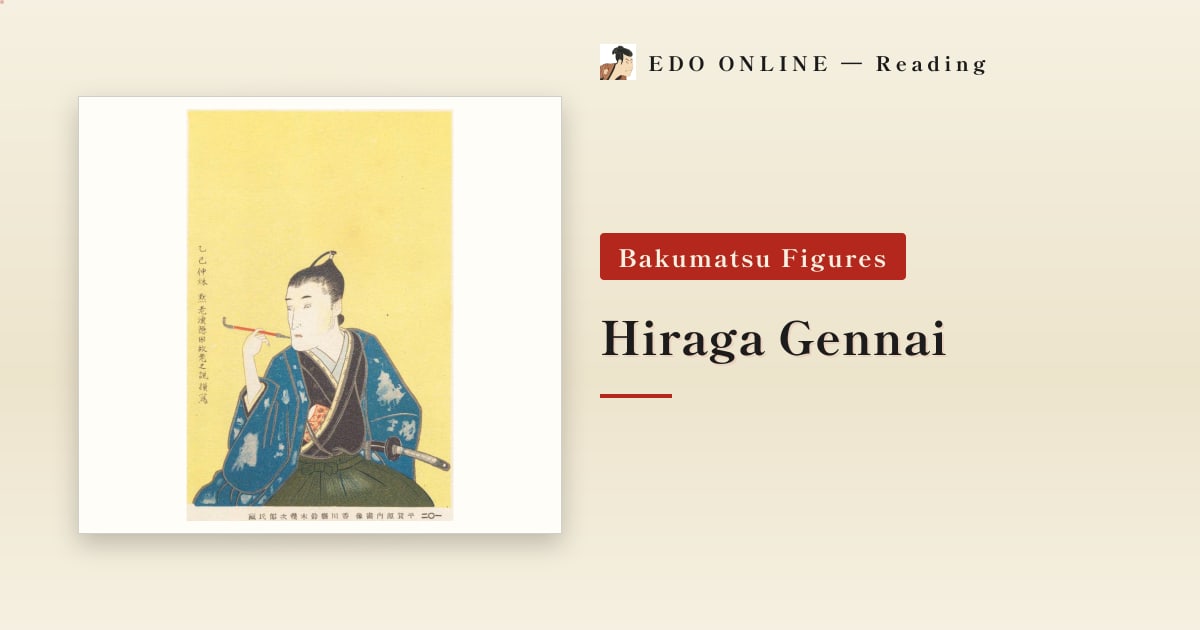
Calling someone impossible to categorize is usually an exaggeration. In Hiraga Gennai's case it is not.
Contents
Who Was Hiraga Gennai?
The list runs like this.
Naturalist. He worked in honzogaku, the classification and study of medicinal plants and minerals, and organized exhibitions of products gathered from across Japan.
Inventor and engineer. He rebuilt an Elekiter, an electrostatic generator; produced kakanpu, a fireproof cloth made from asbestos; and worked on mine development.
Satirist. He wrote sharp popular fiction and scripts for the puppet theatre.
Painter. He studied Western technique and worked in oils.
He was born in Sanuki Province, now Kagawa Prefecture. The year is conventionally given as 1728, though other dates are proposed and the day of his birth is unknown. Exposure to Dutch learning at Nagasaki set the direction of everything that followed.
Hiraga Gennai's Elekiter
The Elekiter is what made his name.
It was a friction machine for generating static electricity, brought in from the Netherlands. Gennai is said to have acquired one in broken condition and restored it to working order.
Its uses were spectacle and medicine. Electricity was believed in contemporary Europe to have therapeutic applications, and Gennai treated it the same way.
It was not a generator in the sense of supplying continuous power, but it was a working frictional machine that really did produce static charge — and one of the first demonstrations of electrical phenomena in Japan.
Did Hiraga Gennai Invent the Midsummer Eel Day?
The custom of eating eel on the "day of the ox" in midsummer is popularly credited to Gennai.
The story goes that an eel seller, unable to shift stock in the heat, asked his advice, and Gennai told him to hang a sign reading "Today is the day of the ox" — after which business boomed.
No contemporary source supports it. The tale appears in later writing and is best treated as legend.
That it attached itself to him, however, is not accidental. He was known for exactly this kind of promotional flair — staging exhibitions, marketing his own work, manufacturing attention. The anecdote is a verdict on his reputation rather than a record of an event.
What Went Wrong for Hiraga Gennai
Versatility did not translate into success.
Most of his ventures failed commercially — the mines, the fireproof cloth, an attempt at wool production. Either the period had not caught up with him, or he could not stay with one thing. Both readings are defensible.
He never settled into a stable position, acquiring patrons and losing them repeatedly. That instability produced both the range of his talent and the poverty of his circumstances.
How Hiraga Gennai Died
In 1779 Gennai killed a man and was arrested.
Accounts of what happened differ and no settled explanation exists. A misunderstanding during a drinking session is one version; mental instability is another.
He died in prison in January 1780. His age is traditionally given as fifty-two by the older count; with his birth date unfixed, his age in completed years cannot be established.
His friend Sugita Genpaku wrote his epitaph, to the effect that here lay an extraordinary man, who loved extraordinary things, and whose conduct was extraordinary — so why did he have to die in an extraordinary way as well?
It is written as a lament rather than a tribute, and it summarizes the life better than any list of achievements.
Hiraga Gennai's Grave
His grave stands at Hashiba in Taito Ward, Tokyo. Sosenji, his family temple, later moved to Itabashi, but the grave was left on the old temple grounds. His former residence and a memorial museum stand in Sanuki, Kagawa Prefecture.
Hiraga Gennai Timeline
| Year | Event |
|---|---|
| c. 1728 | Born in Sanuki Province (now Kagawa); the year is disputed |
| 1750s | Encounters Dutch learning at Nagasaki |
| 1760s | Organizes product exhibitions in Edo; becomes known as a naturalist |
| 1770s | Restores the Elekiter; writes fiction and puppet plays; paints in Western style |
| 1779 | Kills a man and is imprisoned |
| 1780 | Dies in prison; traditional age at death, 52 |
For his contemporaries in Dutch learning see Sugita Genpaku and rangaku and the Tekijuku.
Related reading
Abe Juro — The Former Member Who Talked
He deserted the Shinsengumi and rejoined under another name, shot at Kondo Isami as one of the Goryō Eji, and then grew apples in Sapporo. His late-Meiji testimony is where the ranking of the corps' best swordsmen comes from.
Ando Hayataro — The Shinsengumi's Record-Breaking Archer
He set the standing national record in the long-range shooting at the Tōdai-ji Great Buddha Hall, sending 8,685 arrows the length of the corridor. Nearly fifty, he joined the Shinsengumi and died of wounds taken in the back garden of the Ikedaya.
Hattori Takeo — Two Swords at Aburanokoji
A two-sword master and fencing instructor of the Shinsengumi who defected with the Goryō Eji. At Aburanokōji he alone wore mail, held a wall against the whole corps, and fell with more than twenty wounds.