EDO ONLINE

EIKETSUDEN / EIKETSUDEN

Katsu Kaishū

He saved a city of a million without drawing his sword.

COMING SOON4 days until launch

Event periodAug 29, 2026 08:00Sep 25, 2026 20:00

Bakumatsu Edo. Born into a poor hatamoto house that had bought its rank, he crossed the whole of his age without cutting down a single man. Eiketsuden: Katsu Kaishū is a limited-time event that retraces his seventy-five years through woodblock scenes and story — and lets you live them.

Sign up / Log in with Google
Learn more about EDO ONLINE

Opening soon. Sign up now and be ready for launch.

Who was Katsu Kaishū?

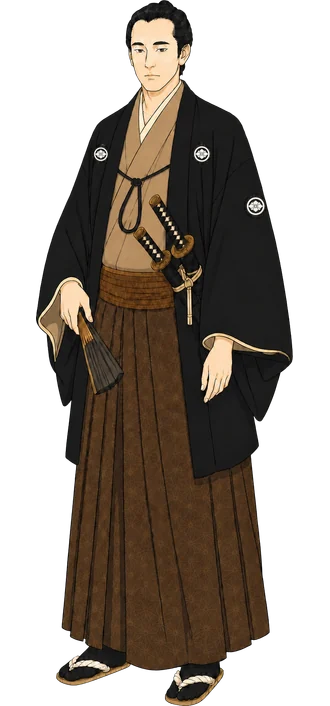
Katsu Kaishū (1823–1899) was a shogunal retainer who lived from the closing years of the Edo period into Meiji. He was born in 1823 at Honjo Kamezawa-chō in Edo. His house was hatamoto in name, but its standing is said to have been bought with his great-grandfather's money, and it lived near the bottom of Edo's warrior class. He is said to have trained under Shimada Torinosuke and earned his licence in swordsmanship — yet he never cut down a single man in his life. He himself said he tied the hilt of his sword to its scabbard with a cord, so that it could not be drawn.

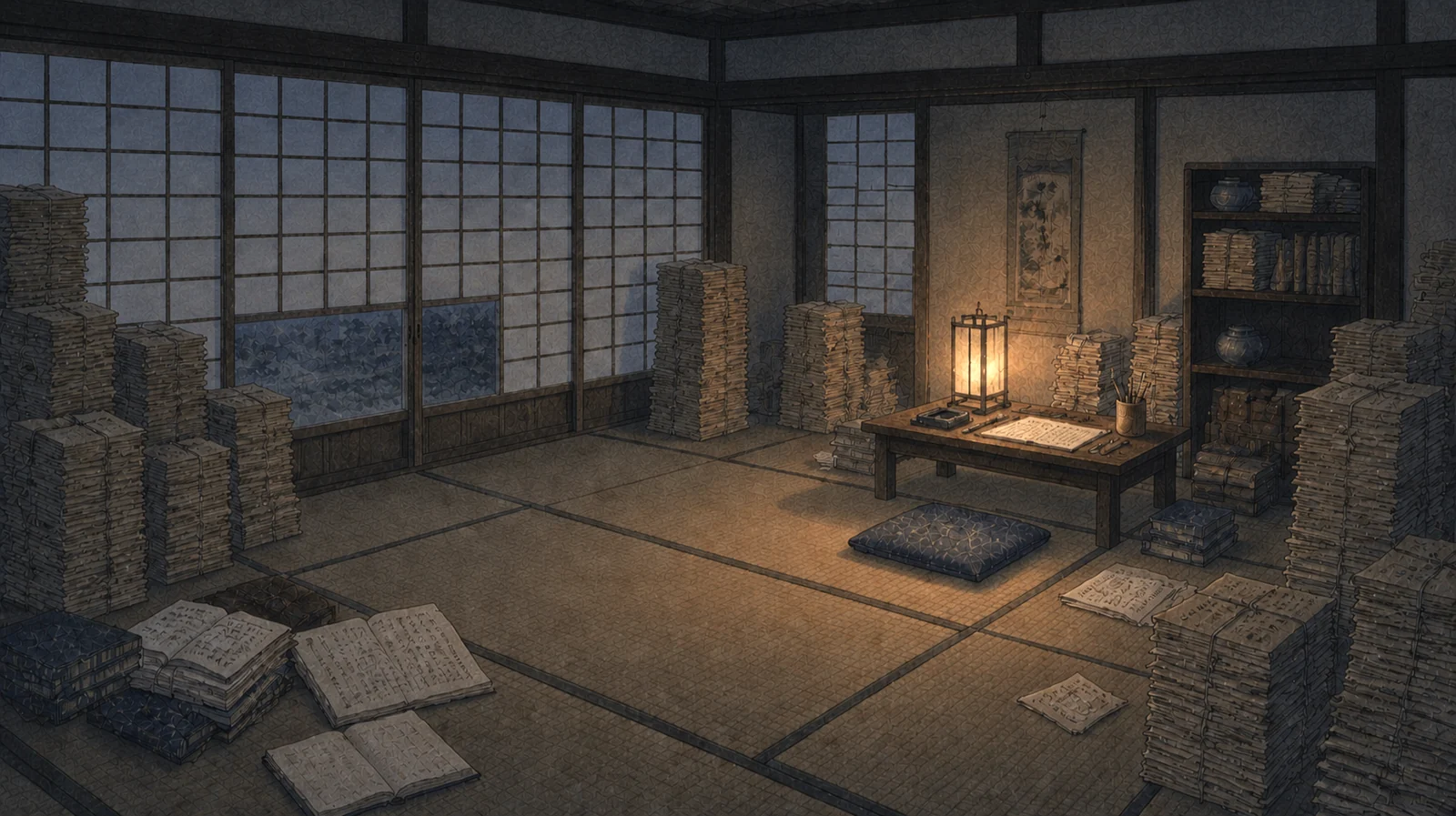
He taught himself Dutch, and over a year copied out the Dūfu Haruma dictionary twice, selling one copy to pay the loan on the book. In the year the American ships came, a single memorial on coastal defense caught the eye of the senior councillor Abe Masahiro, and an unknown low-ranking retainer stepped onto the stage of history. He spent five years at the Nagasaki naval school, and in 1860 crossed the Pacific aboard the Kanrin Maru. He was, however, neither her captain nor her commander, and seasickness kept him in his cabin for most of the voyage. He was the man who built a navy, not a fine hand at sea.

He opened a naval training center at Kōbe and took in Sakamoto Ryōma, a runaway from his domain, as a pupil. In 1868, when the shogunate had become the side being folded up, Katsu made ready to burn Edo and only then sat down to talks with Saigō Takamori. Yamaoka Tesshū's advance negotiation, the petitions from the inner palace, the pressure of the foreign powers — every card was laid out, and in two days a city of a million was spared the fire. He lived thirty years into Meiji, keeping the old shogunal retainers fed while being accused of bending his principles, working to restore Saigō's honor, and bringing about an audience for his old lord Tokugawa Yoshinobu. Ten months after that, he collapsed on stepping out of the bath and died, aged seventy-five.
Read more in our feature

Relive a whole life

8 chapters. Trace his life through woodblock scenes and story.

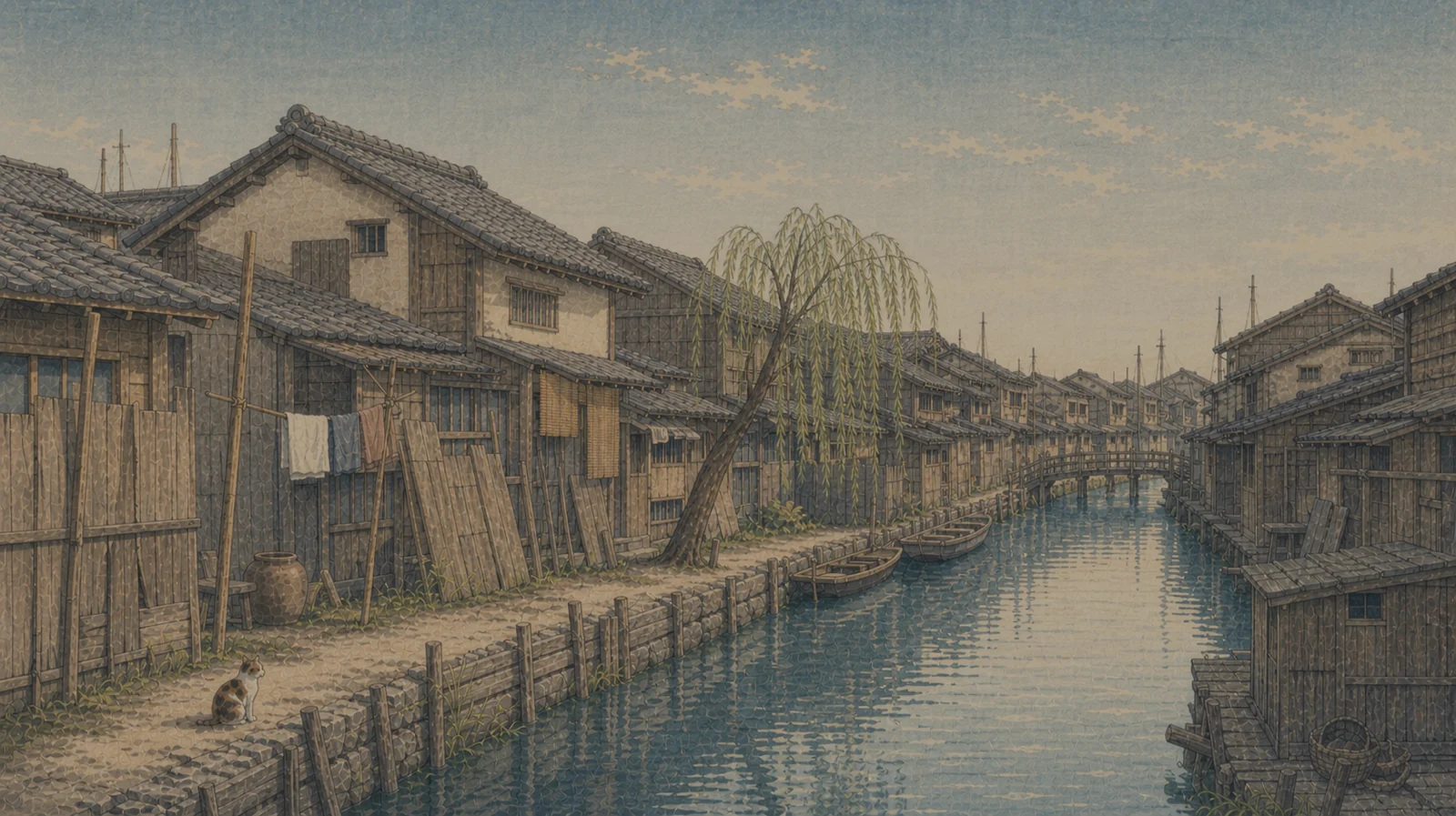
Honjo Kamezawa-chō
Honjo Kamezawa-chōEast of Edo, a quarter of canals and back tenements, where a hatamoto house stood that had bought its rank.
Chapter 11823

Honjo: The House of Katsu

The spring of Bunsei 6. In a small residence in Honjo Kamezawa-chō, east of Edo, a boy was born. His common name was Rintarō, heir to the Katsu, a hatamoto house. A hatamoto was a direct retainer of the shogun, which sounds well enough. But the true state of this household stood near the very bottom of Edo's warrior class.

The Katsu were not, in fact, a warrior house by birth. Rintarō's great-grandfather, known as Yoneyama the kengyō, was a blind man born in Echigo. He made his way to Edo, built himself up as a moneylender, and with what he saved bought a gokenin's title—so the story runs. The samurai standing of this house was not something handed down through generations. It had been purchased.

The Hyōkai Juku
The Hyōkai JukuA room of Dutch learning, copied volumes stacked under an andon lamp — the desk where a dictionary was written out twice.
Chapter 21845

The Dutch Years

In Kōka 2, the first man Rintarō called on was Mitsukuri Genpo, a scholar of Dutch of the very first rank. To study under him would have been the best of all outcomes. He was refused. No reason for it has come down to us.

A man who has been turned away does not have somewhere else lined up. Teachers of Dutch in Edo could be counted on the fingers. Rintarō went about anyway, and at length managed to enter under a scholar named Nagai Seigai. Entry, of course, required a fee. For a man without money, learning was first of all a question of coin.

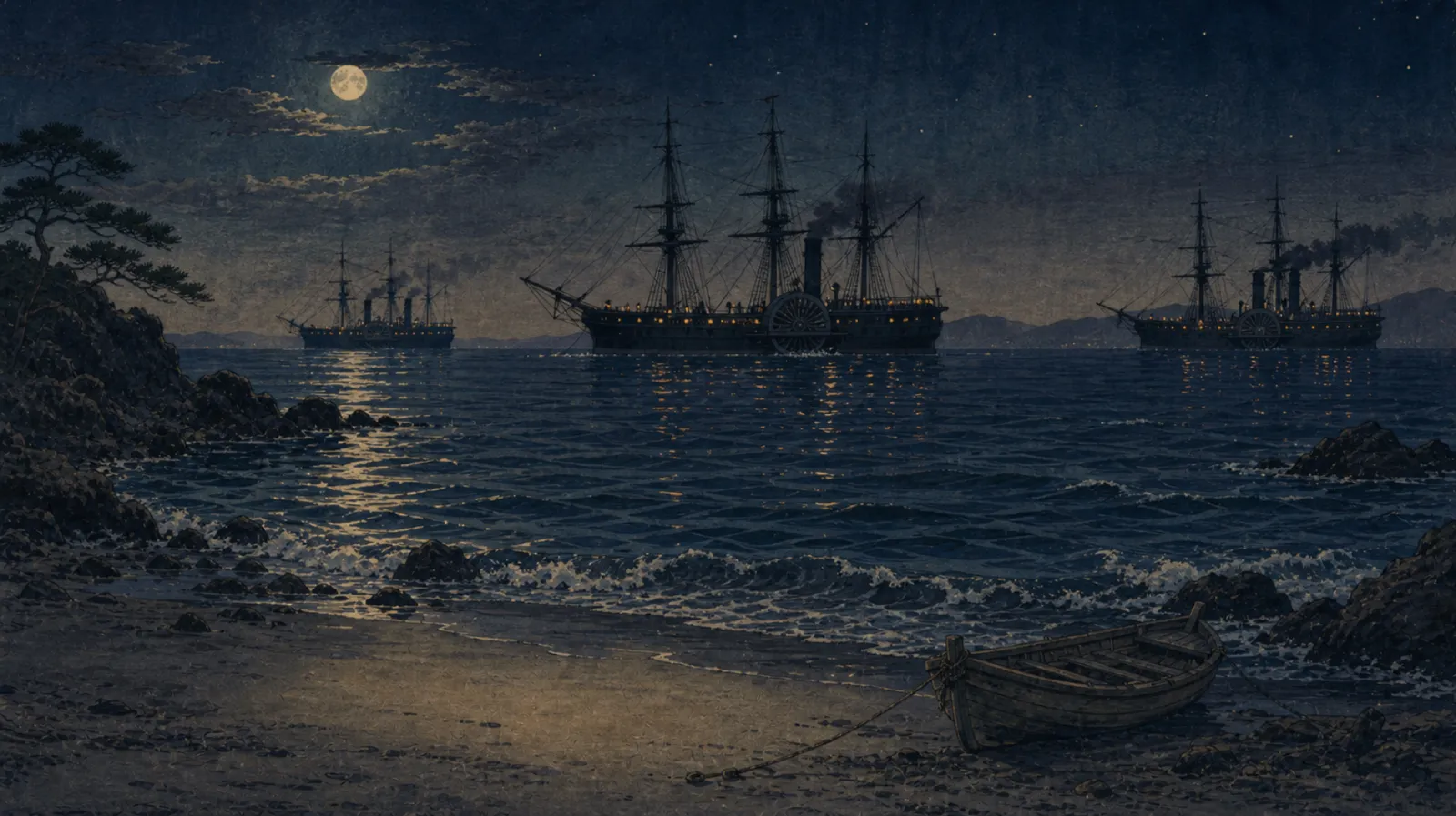
The Black Ships
The Black ShipsPerry's black ships moored in Shimoda bay by night — the eve of the failed crossing.
Chapter 31853

The Memorial on Coastal Defense

In the summer of Kaei 6, four foreign ships appeared off Uraga. Two of them belched smoke and made way against the wind—ships that did not depend on sails. Aboard was the American envoy Perry, and what he carried was a letter demanding that the country be opened.

Edo was thrown into terror. For more than two centuries this had been a city that never seriously imagined soldiers arriving from across the sea. People bundled up their household goods to flee, merchants cornered the rice, and samurai dragged out rusted armor. But nowhere was there a man who possessed any means of stopping four ships.

The Nagasaki Naval Academy
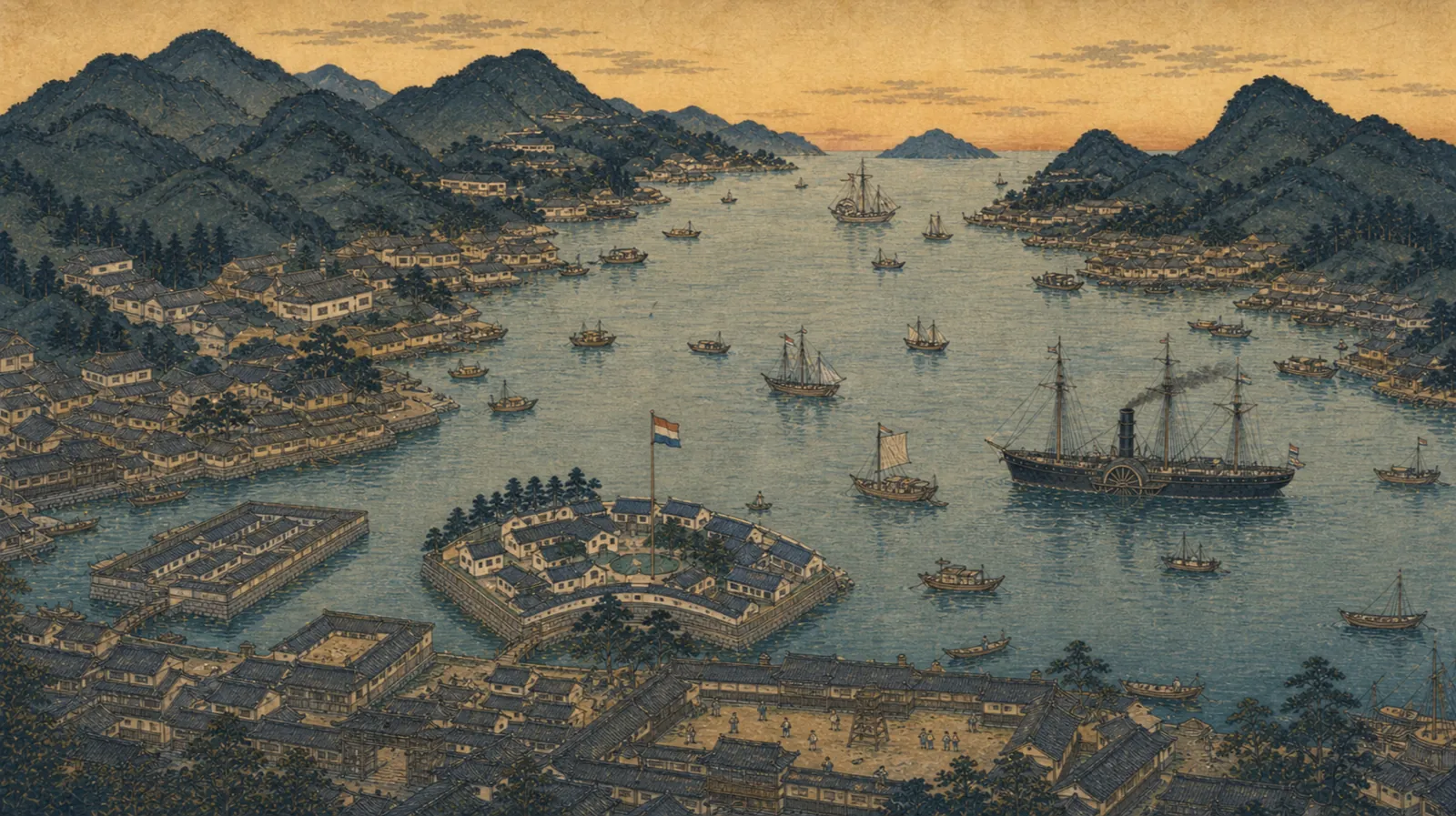
The Nagasaki Naval AcademyThe inlet facing Dejima — the school of the sea where five years were spent under Dutch instructors.
Chapter 41855

The Nagasaki Naval School

In Ansei 2 the shogunate finally committed itself to building a navy. The place was Nagasaki, the harbor that had been the country's one window for two centuries. For instructors it turned to the Dutch, who had stood on the other side of that window. They even sent over a steamship for training: the Kankō Maru.

Rintarō was chosen as one of its students. He had written the memorial on coastal defense and had been translating Dutch books; the choice was a natural one. He left Edo and went down to Nagasaki—a late setting-forth, past the age of thirty.

The Kanrin Maru at Sea
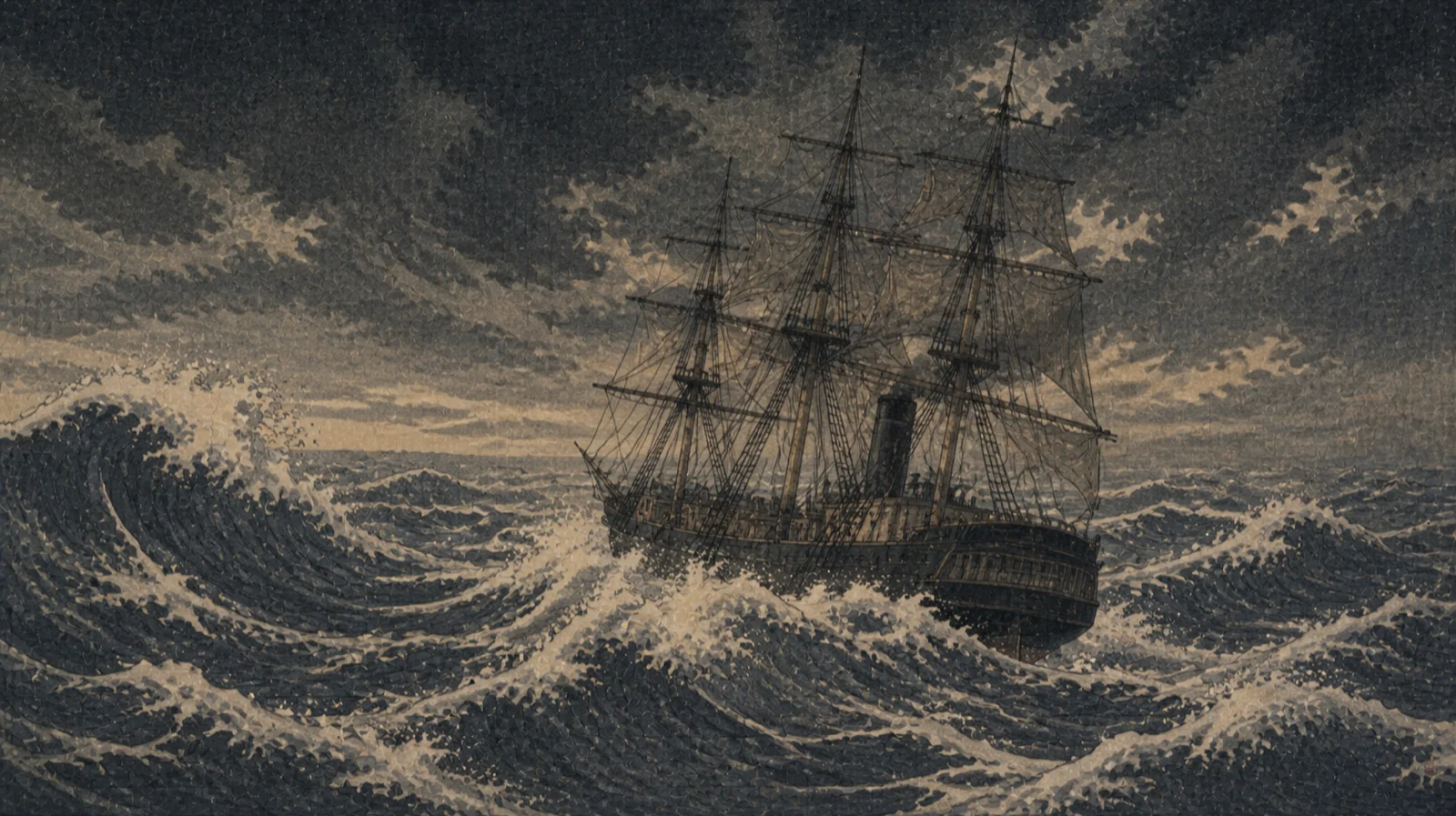
The Kanrin Maru at SeaA three-masted warship in heavy weather on the open ocean — a cabin of seasickness and waves that never stop.
Chapter 51860

The Kanrin Maru

In the first month of Ansei 7—the era would not change to Man'en until the third month of that year—a ship left Shinagawa. She was the Kanrin Maru, a steamship the shogunate had bought from the Dutch. Her destination was America. She sailed as escort to the embassy going to exchange the ratifications of the treaty of amity and commerce.

The officer responsible for the ship was Kimura Settsu-no-kami Yoshitake, commissioner of warships. Rintarō's title was head of instruction at the naval training academy; he was not her captain. Aboard as well were the crew of a wrecked American vessel—Lieutenant Brooke and his men, professional naval officers—nominally being carried home.

The Kōbe Naval Training Center
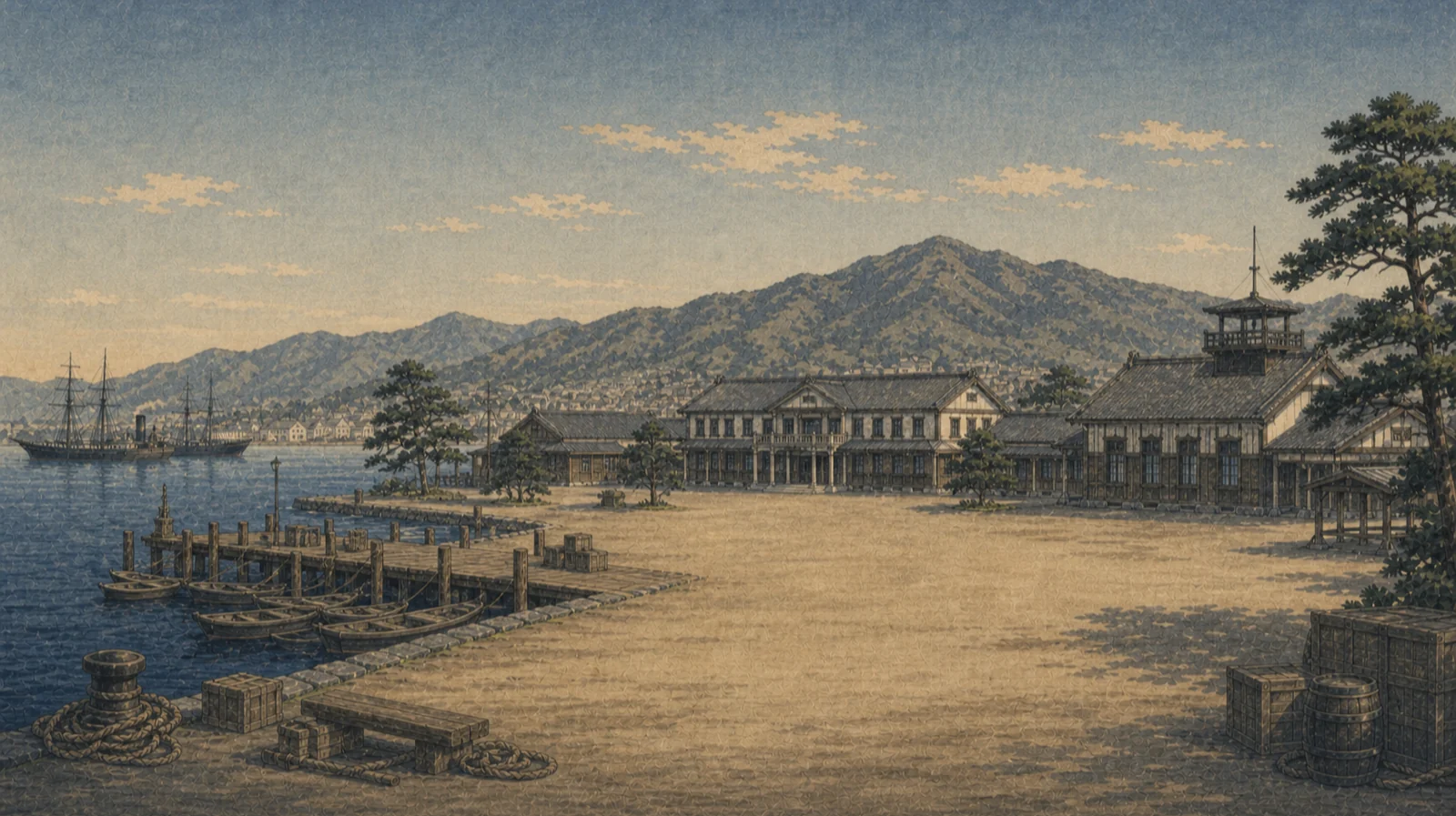
The Kōbe Naval Training CenterA landing where men gathered without regard to rank, runaways from their domains sitting among the rest.
Chapter 61862

Kōbe and Ryōma

In Bunkyū 2, Rintarō was appointed deputy commissioner of warships, with an office stipend of a thousand koku. A man who had once sat in the unposted pool now held a position directing the practical work of a navy. It was a late advancement, on the verge of forty.

But holding a post does not conjure money. Funds to buy ships, a place to train men, machinery to send men there—all of it had to be extracted by dealing with the shogunate's bureaus. Most of the time he spent went not on the water but in negotiation, on tatami.

The Satsuma Residence at Tamachi
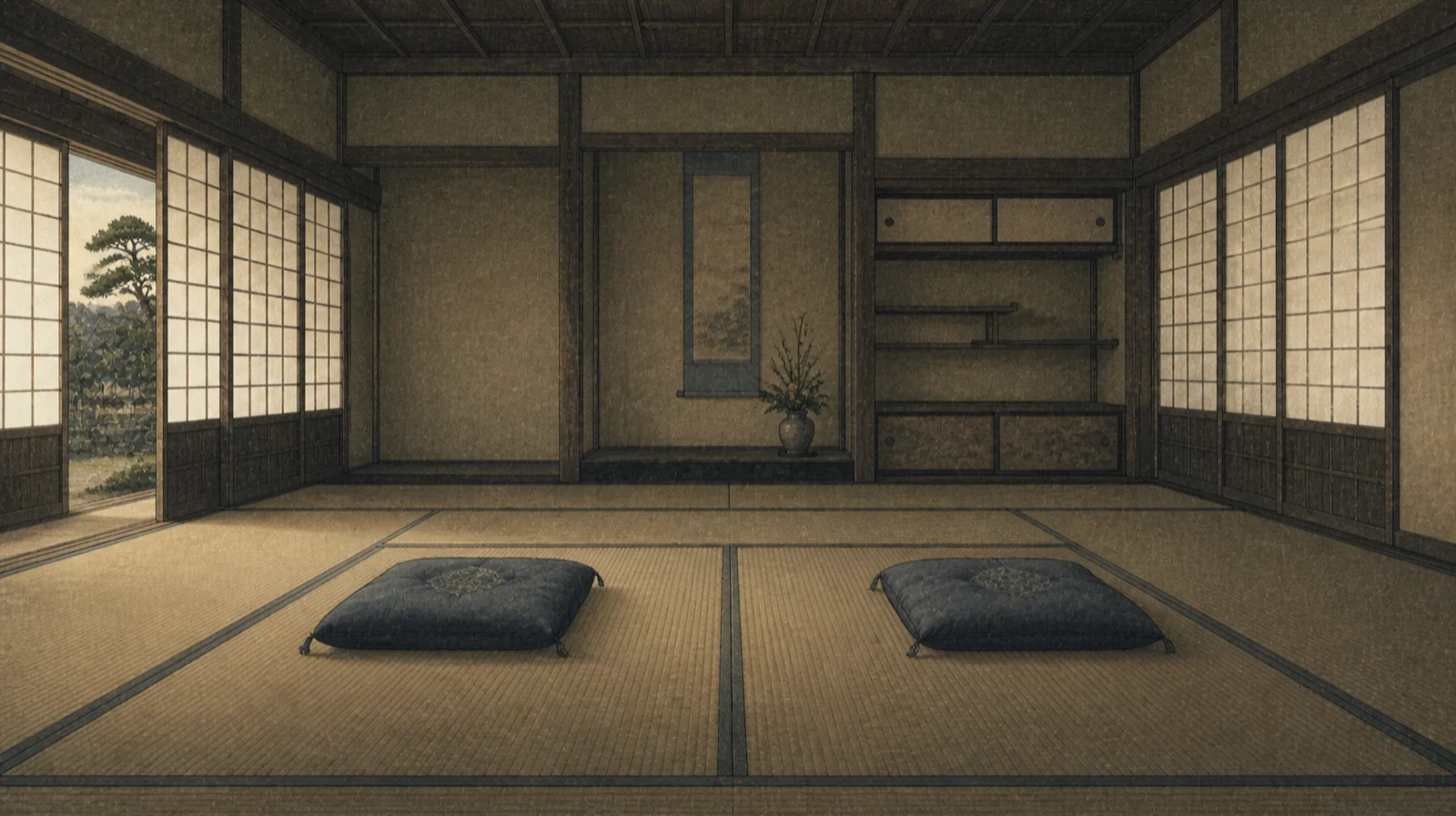
The Satsuma Residence at TamachiThe room he entered having first prepared to burn Edo — two cushions set facing one another.
Chapter 71866

The Surrender of Edo

In Keiō 2, Kaishū was released from confinement and restored as commissioner of warships. The reason he was called back was simple: the shogunate had lost its war with Chōshū. The second expedition had collapsed on several fronts and the shogunal forces were falling back. Somebody had to settle the aftermath.

The task fell to Kaishū. He went to Miyajima in Aki and faced the Chōshū side at the temple Daigan-ji—Hirosawa Saneomi, Inoue Kaoru and others. Men who had been exchanging fire until very lately now sat in the same room to talk of an armistice.

The Hikawa Sitting Room
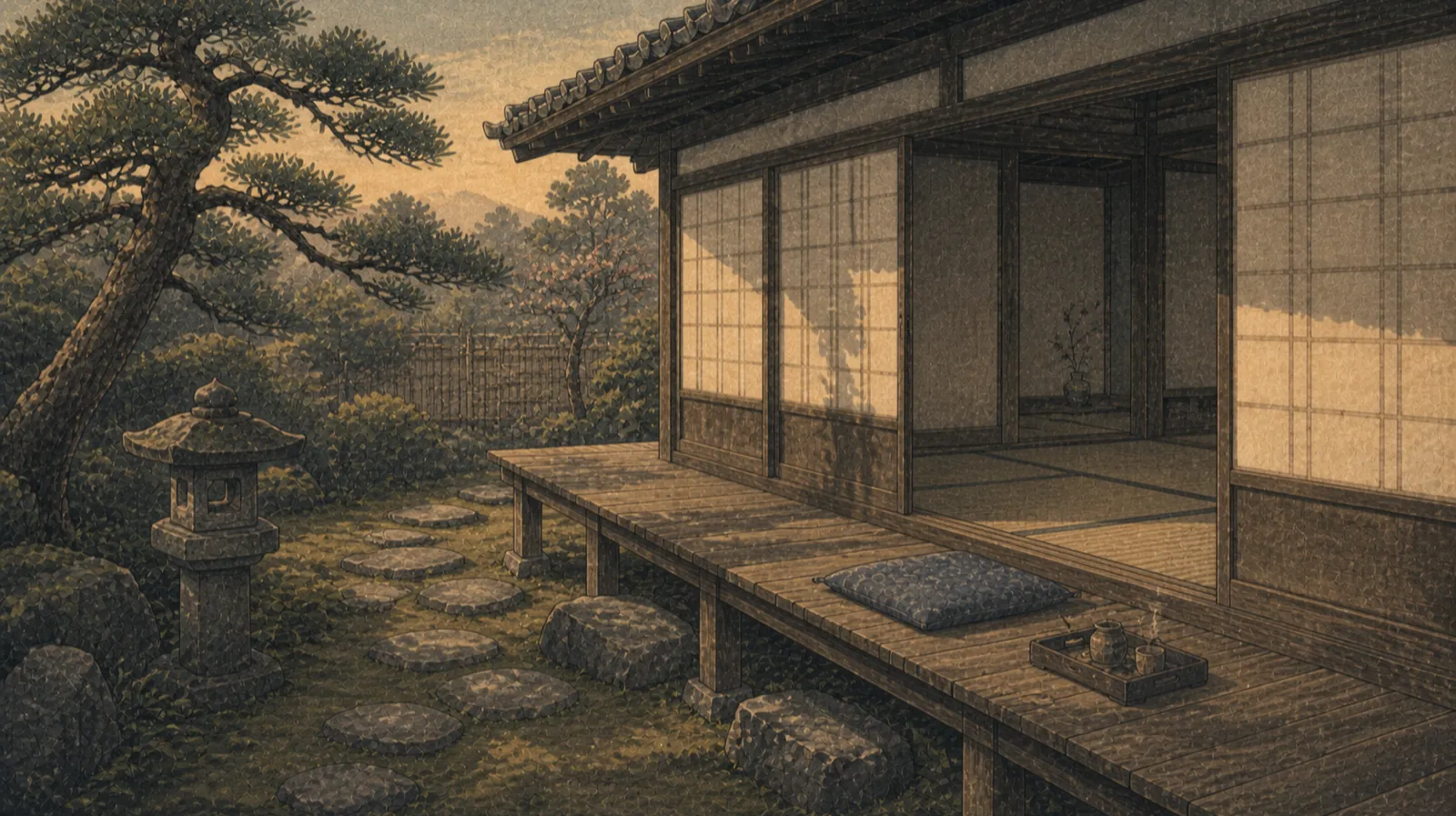
The Hikawa Sitting RoomAkasaka Hikawa in the Meiji years — a veranda onto the garden, and a room where the talk never ran out.
Chapter 81869

Thirty Years at Hikawa

Edo was handed over, and the house of Tokugawa was moved to Sunpu. A house whose own domains ran to four million koku—seven million if the fiefs of its bannermen are counted in—was cut down to seven hundred thousand. Of the retainers who followed it, very nearly all lost their livelihoods. Counting the hatamoto and gokenin with their families, tens of thousands of people were about to be turned out onto the road.

Katsu Yasuyoshi—the name he used from the Meiji era on—went down to Shizuoka as well. The new government pressed him repeatedly to take office, and he kept refusing. What he had to do first was to somehow put a floor under the lives of the former shogunal retainers who had nowhere to go.

The words he left

Collect his sayings and poems along the way.

  • In all my life I have seen two men in this realm who frightened me: Yokoi Shōnan and Saigō Nanshū.
    From his late-life talks, the Hikawa Seiwa. One of the two men he called frightening was the one he faced over the surrender of Edo — and the one whose honor he would later work to restore.
  • You must not acquire a taste for killing men.
    Said to Okada Izō, his bodyguard, in his late-life talks, the Hikawa Seiwa. Izō answered that but for him that night, the master's head would already have been off — and Katsu said he had not a word to give back.
  • Burn the streets, cut off their advance and their retreat, and make of it a scorched waste.
    From the Kainanroku — the scorched-earth plan prepared in case the talks over Edo broke down. The man who settled it without a battle had first made ready to burn the city.
  • Only — it would be a hard thing for the shogun's men to starve. That much I ask of you.
    Said at the talks with Saigō Takamori over the surrender of Edo, as recorded in his late-life talks, the Hikawa Seiwa. With the fate of a city of a million on the table, this was what he asked for himself.
  • A man's way of meeting the world is simply this: face what is in front of you with an honest heart and a straight mind.
    From his late-life talks, the Hikawa Seiwa. Not how later ages will speak of you, but how you answer the matter in front of you. The secret of living, he went on, is the single word sincerity.
  • That's the end of that.
    Said to be his last words. He collapsed after a bath on the nineteenth of January, 1899. Not a long testament, nor an injunction to carry on his will — only the words of a man closing up shop.

Pursue his learning through discipline

Each action raises a discipline and unlocks the next stage of the story.

  • Western Learning

    Learned under Nagai Seigai, and a dictionary copied out twice in a year. When the country opened he switched to English: the language of the window changed, but the power to puzzle it out remained.

  • Statecraft

    How a country is folded up and how it is built again — the coastal-defense memorial, the plan for a navy, the reckoning that kept the old retainers fed.

  • Seamanship

    Five years at the Nagasaki academy and a Pacific crossing — though he was never a fine hand at the helm himself.

  • Negotiation

    Negotiation is not glibness but the number of cards laid down — the truce at Miyajima, the meeting with Saigō, the reply to Fukuzawa.

  • Standing

    The breadth to take pupils without asking their rank, and to restore the honor of the general who stood against him.

  • Composure

    Set upon nine times and never once drawing — the nerve to sit down to talks having first prepared to burn the city.

What I did is mine. Praise and blame are other men's business — no concern of mine, and no part of me.
From his reply to Fukuzawa Yukichi's Yasegaman no Setsu, dated the sixth day of the second month, 1892 — sent the day after Fukuzawa's letter, and with leave to show it to anyone.

Trace his life, now.

Sign up / Log in with Google

A limited-time event in the Japanese-style RPG EDO ONLINE

All Eiketsuden events